I am a 61 year old, father of two boys and have been happily married for 33 years. I have been a Physical Education teacher and coach for 38 years and have loved EVERY minute of it. I enjoy making people laugh and feel good about themselves. It’s fun collecting inspiring and heartwarming stories.from people. So, if you have a good story…let me know! I hope you enjoy my page!! :)
Remember:
Everyone is fighting a battle that you know nothing about.
Be kind.
Always.
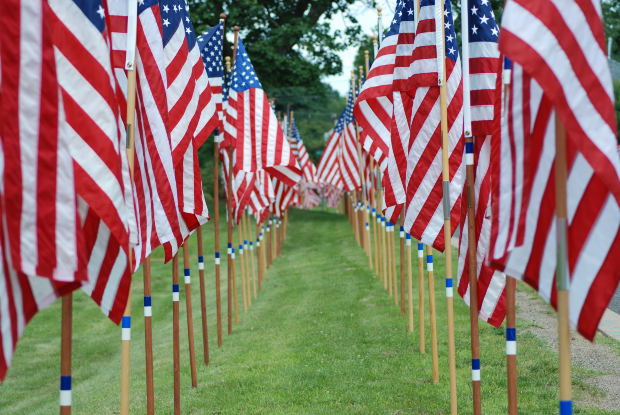
Photo Credit: Karen Arnold via publicdomainpictures.net
Veteran’s day has come and has past but that doesn’t mean that we should ever forget what our young men and women have fought, sacrificed, and gave parts of their lives for. Today, I came across this really interesting article on huffingtonpost.com that presented us with some fascinating and strange stories of service men and women during their time in the military. The stories were collected by Ripley’s Believe It or Not. These are simply AMAZING stories!!
Some of the stranger stories that deserve to be retold:
In 1943, Master Sgt. John Hassebrock of Buffalo Center, Iowa, received a three-day pass to marry a WAC Corporal before he went overseas. They lost track of each other until one night in France, he made a convoy to the front lines and went to a farmhouse to spend the night. There he unexpectedly ran into his wife — on the exact day and hour of their wedding one year earlier.
During World War II, Gunner’s Mate Allen C. Heyn was saved three times in three minutes by his equipment. When his boat, the Juneau, was sunk by a Japanese submarine, his life was saved by his helmet, which was crushed and his skull fractured. Two minutes later, he sank with the ship, but his life jacket brought him up to the surface, where he was saved by a raft. He was the only survivor of the 12 men on that raft.
Private Leo Carrara of the Sixth Armored Division was truly the indestructible man. A German bomb destroyed his half-track and killed 12 men and only Pvt. Carrara escaped, although he was badly wounded. His sergeant tried to save him and was killed, his lieutenant tried to save him and was killed and his litter bearer tried to save him and was killed.
Lt. Commander Robert W. Goehring, aboard the Coast Guard Cutter U.S.S. Duane, was swept off his ship by a mountainous wave during a storm. The ship was turned around to rescue Goehring when suddenly another giant wave tossed him back on board to safety.
Joe Frank Jones of the Eighth Army Air Force fell 13,000 feet and suffered no broken bones. Returning from his 22nd mission over Germany in a Fortress, he collided in mid-air and fell 13,000 feet in the severed tail section of his plane — without serious injury and no broken bones.
During the Korean War, Lt. Fred J. Fees, Jr. continued to direct air strikes after he had been shot through the head.
Also during the Korean War: Walter J. Alliman carried an 1855 penny that brought good fortune to fighting men in 5 previous wars.
James Ward of La Grange, N.C., enlisted in the Army at 14, served two years, including five months in combat in Korea, and was made a sergeant. Then he was discovered and was discharged for being underage.
U.S. Infantryman Donald Morehouse was shot through the chest while fighting in the Korean War. Still, he walked 35 miles to safety — and only discovered later that the bullet had gone through his heart.
Bob Weiland, who lost both legs in 1969 in Vietnam to a land mine while trying to save a fellow soldier, “walked” 2,000 miles from California to the Vietnam Memorial in Washington, D.C., in 1986 — propelling himself on his padded knuckles.
Pvt. William Parker, a soldier in the U.S. Army fighting in Vietnam, survived after a shot to his head was deflected by the bible he kept underneath his helmet.
Pfc. Billy Campbell of the 101st Airborne Division serving in Vietnam, survived being shot in the chest when the bullet deflected off a spoon he was carrying in his breast pocket.
During the Vietnam War, American soldiers tossed “Slinky” toys over tree branches to serve as radio antennas.
Wayne Reymar of Alberta, Canada, had two pieces of shrapnel removed from his chest 32 years after he was wounded during the Vietnam War.
While fighting in Afghanistan, U.S. Army Pvt. Channing Moss survived a body hit from an anti-vehicular rocket when the explosive head broke off just before he was impaled by the rocket shaft.
U.S. soldiers in Iraq use a child’s toy, Silly String, to detect tripwire-activated traps.
Jim Dillinger, a 45-year-old retired soldier from Mount Orab, Ohio, spent a year-long tour of duty in Iraq as a combat engineer — due to a clerical error.
For the help he provided to residents of Iraq, the locals have made U.S. Army Staff Sgt. Dale Horn an honorary Sheik.
Take the time EVERY day to thank a soldier or a veteran for everything that they have done for our country!
The love between a child (or adult) and their dog is boundless, special and at times can be very healing. Today’s picture demonstrates an awesome example of that kind of heartwarming relationship.
Photo Credit: George Hodan via publicdomainpictures.net
This is a story that took place in the south and involved a little boy and his mom. It shows us the sad side of war and reactions that a family endured at the loss of their loved one. Get a box of tissues ready as you read this story of a little boys love of rhis mom and dad.
Tommy’s Maw Maw and Pappy used to take Tommy to church every Sunday before his Pappy left to go to war.
Tommy had learned early in life all about God and how to pray. Every night Tommy would kneel by his bed and pray before going to sleep.
Today is the day the soldiers are to come home. Tommy and his Maw Maw dressed and went and stood at the dock waiting for his Pappy to arrive. They would wait and wait… Until the last boat left the dock but Tommy’s Pappy would not be arriving this day.
When they got home Tommy was too tired to care about eating. He kissed his grand mother goodnight and went straight to his room. He changed into his pajamas and knelt by his bed.
Lord,
It’s Tommy.
We stood at the dock all day. Every one walked away and we just stood there. Pappy must have missed the boat so we waited for the next one then the next one until all the boats were gone and the tall man in the uniform said all the soldiers had gotten off but he is wrong ’cause Lord, Pappy didn’t get off none of those boats. I hate it when maw maw cries Lord. Please send Pappy home so she will stop crying.
Thank you.
All week long Tommy listened as his Maw Maw cried. He heard her on the phone several times asking about why his Pappy didn’t come home like the rest of the soldiers. On the seventh night he knelt by his bed and prayed.
Lord ,
It’s Tommy .
It has been a long week. Maw Maw just sits and stares out the window when she ain’t cooking and cleaning or on the phone asking where Pappy is and why they didn’t send him home.. She hasn’t hardly spoke in days other than when she is on the phone.
Mrs. Nelly Baker from down the road came by to see if Pappy had come home yet but he hasn’t and Maw Maw began to cry again as Mrs. Nelly Baker talked to her. I heard her say You might have Pappy with you Lord. If you do , could you please tell him it is time to come home ’cause Maw Maw and me miss him and Maw Maw cries at night and calls for him. I’d sure ‘preciate it if you would.
Slowly the days passed by, then weeks. Every day was more of the same. Tommy was worried about his Pappy and his Maw Maw. It had been a little over a month now and Pappy still hadn’t come home. He walked in the living room and there his Maw Maw sat staring out the window until a knock came upon the door. A man in a uniform stood at the door. He backed up and Maw Maw walked outside. His Grand Mother screamed falling to the ground. Then the women in the neighborhood came running.
Tommy was confused. Why was his Maw Maw screaming and crying Pappy was coming home finally. He felt heavy hearted, So he went and knelt by his bed and prayed.
Lord,
It’s Tommy.
It’s been a month and three days since Maw Maw and I went to meet Pappy at the dock. Some man in a uniform just showed up at Maw Maw’s door and made her scream. He ‘pologized for making her scream and cry before he left. Mrs. Nelly Baker and some other women came running . I guess they heard Maw Maw screaming before she fell to the ground.
I don’t understand Lord. Why is she so upset ? The man said Pappy would be coming home tomorrow with something in a pine box. Don’t know why he needs a box. I guess he lost his suitcase. I thank Lord for sending Pappy home.
Tommy didn’t know his Maw Maw stood silently by the door. She listened as the little boy of ten prayed through sobs.
Lord,
It’s Tommy .
I un’ stand now. My Pappy came home today. I know all about the pine box now. I guess I forgot to ask for you to send him back to Maw Maw alive. I hope she will forgive me. I thought You knew what I meant when I asked you to bring my Pappy home. But you did do what I asked. I made a mess of things. Now my Maw Maw will never be happy again. Lord, the next time I ask for something make sure I ask the right way please and tell Pappy I am sorry I got him dead I didn’t mean to. It’s all my fault Maw Maw is sad. I am so sorry.
Tommy opened his tear stained eyes to see his Maw Maw standing in his doorway , tears streaming down her face. ” Dear child, it is not your fault.” She said through sobs and held her arms out to him. ” If it had not been for your prayers, your Pappy may never had come home at all.”
The following is a collection of stories, accumulated and written by Judith Blakely a Yahoo Contributor. It gives us glimpse of the sacrifice and courage that our soldiers gave our nation. Let’s take time today to thank the Veterans that we know for fighting to give us the freedom that we all deserve.
is here. Our hearts go out to the families of our soldiers serving at war. Our thoughts are drawn to the sacrifices of our young men and women overseas. Our memories flash to the past, of the stories of our fathers and grandfathers
Within these next stories, our grandfathers tell of a time of action, adrenaline, death, grief, triumph, pride, humor, and duty.
“Are you sure this is my son?”
Samuel Boynton began his tour in Korea by making the Inchon Landing on September 18, 1950 as part of the F Company 32nd Infantry Regiment 7th Division (better known as the Hourglass). He was immediately involved in the fighting. Boynton recalls: “After making the Inchon Landing, we made an attack on South Mountain. The North Koreans hit us resulting in twelve dead and twelve wounded. We crossed the 18th Parallel about seven times back and forth. The 7th Division was the most traveled division of the Korean War from 1950-1951.”
Upon returning from Korea in November 1951, Boynton was assigned to Escort Detachment at Brooklyn Army Base, Brooklyn, New York. He escorted remains of K.I.A. (Killed In Action), east of the Mississippi. Prior to his first assignment, Boynton attended a two week class on what his duties would become. His job was to meet the N.O.K (Next Of Kin) and the Funeral Director; fold the flag; and arrange for the firing squads with Military and American Legion Guards.
“Everyday I had to read the bulletin board at least two or three times. The names would be posted that many times a day.” On the day of Escort, Boynton would wear his Class “A” uniform with a black armband. “I would go down the stairs to the shipping dock, check the name of the soldier, rank and service number,” says Boynton. The remains would be placed in a Military Ambulance and taken to Grand Central Station to be escorted home. “That’s when the hard part began,” recalls Boynton.
“I remember the first time I escorted a soldier home. It was my hometown of Fall River, Mass.” Upon reaching the soldiers town, Boynton would first meet with the Funeral Director and deliver a copy of the orders. Then, together, they would meet with the N.O.K., “The mother and father, sometimes it was only the mother,” says Boynton. “It didn’t matter where it was: Kentucky, Tennessee, Pennsylvania, Connecticut, Indiana, Illinois, Michigan or Ohio. It never got any easier. The look and those words will always be with me, “Are you sure this is my son?”
“I considered it an honor and privilege to escort these War Heroes into the loving hands of their parents.”
Years later, Sam Boynton found himself serving in a similar capacity during Vietnam. On September 18, 1965, he was sent to Vietnam and assigned to the First Air Calvary Division located in the “Tea Plantation.” Boynton recalls, “Our medical tent and grave registration was set up. When the choppers came in, we unloaded the wounded, then the K.I.A. Sometimes we had to go on a search and recover mission, looking for missing G.I.’s. With four on a team, our helicopters would fly into the jungle. Most of these missions brought more remains into the grave registration.” All remains were processed through Saigon, where identification through medical records could be made. Then they would be shipped home to their families, where someone else would answer the question, “Are you sure this is my son?”
Sam Boynton left Vietnam after four tours in March 1969 and retired from active duty a month later.
Thomas Huntsberry, Teenage Warrior
Thomas was born in Baltimore County, Maryland, on March 13, 1932. He was the youngest of thirteen children. His family held a history of military service, and he was not going to miss his opportunity to follow in his brothers’ footsteps.
“Three of my brothers served during World War II, one in the Army, one in the Marines, and one in the Navy,” says Huntsberry. He attempted to enlist at the tender age of fourteen, but was fifteen before he succeeded.
Thomas says that he had to convince his parents to go with him to a notary public to sign an affidavit stating that he was 17 years old. “In 1948, the Army was taking anybody that was breathing, so with the affidavit, I didn’t have any problem enlisting,” tells Huntsberry.
Sworn into the Army on January 1, 1948, Thomas was sent to Fort Jackson, South Carolina, for basic training. He was assigned to Company H, 3rd battalion, 11th Infantry Division. “I applied for paratroop training during basic. The sergeant looked at me and said, ‘No way are yougoing to be a paratrooper. You are under-age, and I know it, and you know it!’ Then he asked, ‘Do you want to stay in the service?’ I replied, ‘I certainly do!’” Huntsberry fondly remembers.
After basic, he was sent to the Panama Canal Zone, where he remembers that Panama was undergoing unrest due to an election. He says that during guard duty, his friend was nearly shot. “It was a dark night, and the light was out in the guard shack. My friend lit a cigarette, then sat down immediately. Just as he sat down, a 30 caliber round struck the door frame where he had been standing. We were so scared that we never bothered to shoot back. It was a good thing the lights were out because they would have shot us for sure,” relays Huntsberry.
After returning home for emergency leave, Thomas was stationed at Fort Campbell, Kentucky until he was discharged on January 1, 1950.
“I returned to Baltimore and joined the 445th Combat Engineer Battalion, U.S. Army Reserves. In October 1951, we were activated into the Army. Two other reserves and I were sent to Fort Lewis, Washington, as guards for a plane load of fourty-four prisoners who were being sent to Korea. These men had been in the stockade for desertion and for being chronically AWOL. Our orders were to deliver them to front-line units in Korea.”
In 1953, Huntsberry was preparing for an invasion of North Korea, when he learned that an armistice had been signed.
Shortly thereafter, he returned to the States with an honorable discharge. Not wishing to let go of the family feel of the Army, he became an integral part of his local Honor Guard.
Wild Boar Hunting
Towards the end of WWII, Vincent Chinchello, Jr. found himself at Fort Shafter, Territory of Hawaii, as part of the 972nd Signal Service Batallion in the U.S. Army Signal Corp. Underground, the Signal Corp was responsible for maintaining all the Army communications on the island, maintaining all the Army signal equiptment throughout the Pacfic Theatre of Operations, and served as the main link between the Pacific and the Mainland. As there were no infantry troops on the island, a provisional regiment was formed in case of an emergency which never arose. “I was one of the lucky ones,” says Chinchello.
Besides learning how to climb coconut trees (barefooted), he recalls the time the guys went wild boar hunting on the island of Maui. “I fired all eight rounds at him and the guy behind me was laughing!” The boar finally fell ten feet in front of Chinchello. When teased as to the fact that he killed the boar with the first few rounds, Chinchello responded, “I knew it and you knew it, but HE didn’t know it!” The boar was wrapped in palm leaves, buried in a pit of coals, and left to cook the rest of the day. Chinchello says, “I would have never guessed how tender and delicious it would be.”
Note: Vince J. Chinchello, Jr. served in the Regular Army from 1946-1948 and again 1956-1960
Two Tours in Vietnam
On November 16, 1966, Kenneth Wheat joined the United States Army. He went from Fort Ord, California to Fort Gordon, Georgia (for infantry training) to Fort Benning, Georgia (for Airborne training) to Vietnam, all in less than six months.
Assigned to the 9th Infantry Division in the Me Kong Delta, he was a part of the Moblie Riverine Force. In the army just over one year, Wheat was wounded by an enemy force of Viet Cong. The date was December 4, 1967. For that mission, he received The Silver Star for Galantry in Action. After being treated for his wounds at Camp Zama, Japan, Wheat returned to the same unit in Vietnam.
When his first tour in Vietnam was completed, he returned to the United States and became a Military Policeman in Fort Ritchie. After getting married in 1969, Wheat was sent to Germany for one year and then re-enlisted for Vietnam. His second tour of duty was with the 18th Engineer Brigade. Two years later, he returned to Fort Knox, Kentucky.
His assignments included Arlington, Virginia; Korea; and two tours in Hawaii. Retiring on January 1, 1987, he went to work at the Martinsburg Veterans Affairs Medical Center, where he works to this day.
Note: In addition to The Silver Star and a Purple Heart, Kenneth Wheat has been awarded over fifteen medals for his service to this country.
A Purple Heart
“I was shot on March 1, 1970 in the town of Tay-Ninh, Vietnam.” It was April, 1970, and as William Czyzewski lay in his hospital bed at Walter Reed Medical Center, Washington, D.C., he learned the whys and the whats of the day he was shot. “We were cleaning out the area, just before the Americans made a push into Cambodia.” The day is still vivid in his memory.
“I was supposed to go in R&R that day, but I got bumped. We were busting jungle, looking for the enemy. In tanks. We came across a bunker complex. It was the Hilton of bunker complexes. Cement tops. The Captain said, ‘ One man off each tank get down and check out the bunker complex.’ I had an M16. I looked to the right of me, there was a man. There was a man to the left of me. I looked down and there was a beaten path. I couldn’t go anywhere, so I walked down the path.”
“My basic training came back to me, I knew you don’t go down a beaten path, but I couldn’t go anywhere. I had guys to the right and left of me. I started down some steps. I looked down to the left and saw chickens in a pen and smoke from a fire. Just as I turned my eyes in front of me, I saw the muzzle flash.”
“A guy was in the bush. They left a sniper. Just as I saw the flash, I was hit high in the left leg. I went down hard. I heard my mother’s voice telling me to lay there and be still, real still. I was bleeding hard. I laid there until all the fighting was over, then I hollered out that I was hit. A guy from another tank picked me up like a sack of potatoes and threw me over his shoulder and took me out of the jungle. I heard he got a Silver Star for doing that.”
“Next thing I remember, I was laying on a stretcher. Looking up in the sky, I could see the medical helicopter. I heard him on the radio saying that he was getting shot at with 51 caliber fire. I heard the Captain say, ‘ I don’t care, you come down and get this guy or we’ll shoot at you!’ He came down and the guys put me in the chopper. The guys put my booney hat and my pillow, I always had my pillow, they put them in the chopper with me. This guy patted my shoulder and pointed, I lifted up and looked out and saw the mountain and he pushed me back down. My hat and my pillow fell out of the chopper when he did that. I lost them both. They’re somewhere in Vietnam to this day.”
After being unconscious for 48 hours, he woke up in Long-Binh, a Vietnam hospital. He was transferred to a hospital in Japan before finally ending up in Walter Reed. William Czyzewski was medically discharged in February 1971.
After six years, Czyzewski’s leg had to be amputated. He says he’s had his sense of humor through it all and that being on the Honor Guard is his way of repaying the veterans for what they have done for him.
I recently read the following VERY short story about compassion that I thought would be something great to share. It was written by Clifford and Jerie Furness from the book, A 3th Course of Chicken Soup for the Soul.
The person in the story was a child that had a handicap and was going to participate in a Special Olympics competition. It is a terrific act if compassion that will touch your heart….
Kenneth was in junior high school and was excited and eager about participating in a day of Special Olympics events. While his parents watched expectantly from the stands, he ran and won the first race. He was proud of his ribbon and the cheers from the crowd.
He ran in the second race. Just at the finish line, when he again would have won, he stopped, then stepped off the track. His parents gently questioned him. “Why did you do that, Kenneth? If you had continued running, you would have won another race.”
Kenneth innocently replied, “But, Mom, I already have a ribbon. Billy didn’t have a ribbon yet.”
There was once a little girl on a plane. An atheist was sitting next to her, turned and said, “Do you want to talk? Flights go quicker if you strike up a conversation with your fellow passenger.”
The little girl, who had just started reading her book, replied to the total stranger, “What would you like to talk about?”
“Oh, I don’t know” said the atheist. “How about why there is no God, or no Heaven or Hell, or no life after death?” as he smiled smugly.
“Ok,” she said, “those could be interesting topics but let me ask you a question first. A horse, a cow, and a deer all eat the same stuff – grass. Yet a deer excretes little pellets, while a cow turns out a flat patty, but a horse produces clumps. Why do you suppose that is?”
The atheist, visibly surprised by the little girl’s intelligence, thinks about it and says, “Hmmm, I have no idea.”
To which the little girl replies, “do you really feel qualified to discuss God, Heaven and Hell, or the after-life, when you don’t know shit?”
There are times throughout our lives when we all experience situations that can touch our hearts, teach us lessons or remind us how precious our lives are. The following are some very short stories, collected from numerous people, that will warm your heart.
Today, after I watched my dog get run over by a car, I sat on the side of the road holding him and crying. And just before he died, he licked the tears off my face.
———-
Today, someone else’s tragedy provided the miracle my family had prayed for. Thanks to this stranger, my dad will have a heart. It’s so odd to think that an accidental death just saved his life.
———-
Today, after a 72 hour shift at the fire station, a woman ran up to me at the grocery store and gave me a hug. When I tensed up, she realized I didn’t recognize her. She let go with tears of joy in her eyes and with the most sincere smiles said, “on 9-11-2001, you carried me out of the World Trade Center.”
———-
Today, in downtown San Diego, I watched a blue collar Mexican get harassed for being Mexican. It was blatant act of discrimination. And the man actually started crying. As he left the office building, he took off his jacket. His t-shirt underneath read, “I love the USA!
———-
Today, I was traveling in Kenya and I met a refugee from Zimbabwe. He said that he hadn’t eaten anything in over 3 days and looked extremely skinny and unhealthy. Then my friend offered him the rest of the sandwich he was eating. The first thing the man said was, “we can share it.
———-
Today, after telling my grandmother that I didn’t want to risk making such a huge mistake, she looked at me and said, “looking back on it all, there are so many mistakes I wish I had had the courage to make when I was your age.
———-
Today, a 12 year old boy died in a house fire near my neighborhood. After he pulled his mom to safety, he ran back into the burning house for his 5 month old sister.
———-
Today, my blind friend explained to me in vivid detail how beautiful his new girlfriend is.
———-
Today, I was stopped at a traffic light when a middle aged homeless woman asked me for change. I usually don’t give out dollars to the homeless because I assume they are going to buy booze. But I gave her some money anyway. I saw her 45 minutes later at a 7-11 buying bread and peanut butter. She was happy to see me.
———-
Today at the Atlanta airport, as I walked off a plane dressed in my Army uniform, a little girl grabbed my hand and asked me if I would be going back overseas soon. I told her I would in 6 weeks. She smiled and said, Can you please tell my daddy that I love him? My mommy told me he’s never coming home from over there.
———-
Today, as soon as my 5 year old baby brother came into my room, I yelled at him to get out without even looking up at him. When he didn’t listen and I turned around to yell at him again, I noticed that he had a bowl of cherries (my favorite) in his hands. He said, Sorry, I just wanted to share these with you.
———-
Today, I stopped to chat with the office janitor like I do every Monday morning on my way into work. And at the end of our conversation he grinned and said, “you know, you’re the only one who ever stops to talk to me around here, and you’re the President and CEO.
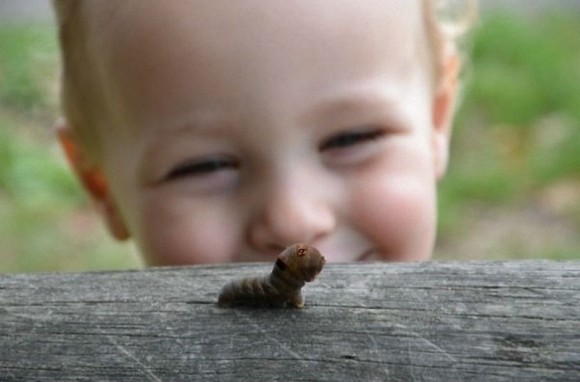
There is nothing nicer to see than the pure innocence and joy of a child fully enjoying the little things in life…such as this little baby caterpillar.
This is a true story sent out by Robert Peterson. It serves as a reminder to all of us that we need to take time to enjoy life, living, and each other.
“The price of hating other human beings is loving oneself less.” Life is so complicated. The hustle and bustle of everyday traumas can make us lose focus about what is truly important and what is only a momentary setback or crisis. Today, tomorrow, be sure to give your loved ones an extra hug, and by all means, take a moment….even if it is only ten seconds, to stop and smell the roses.
She was six years old when I first met her on the beach near where I live. I drive to this beach, a distance of three or four miles, whenever the world begins to close in on me. She was building a sand castle or something and looked up, her eyes as blue as the sea.
“Hello,” she said. I answered with a nod, not really in the mood to bother with a small child.
“I’m building,” she said.
“I see that. What is it?” I asked, not really caring.
“Oh, I don’t know, I just like the feel of sand.”
That sounds good, I thought, and slipped off my shoes. A sandpiper glided by.
“That’s a joy,” the child said.
“It’s a what?” I asked.
“It’s a joy, my mama says sandpipers come to bring us joy.” The bird went gliding down the beach.
“Good-bye joy,” I muttered to myself, “hello pain,” and turned to walk on. I was depressed; my life seemed completely out of balance.
“What’s your name?” She wouldn’t give up.
“Robert,” I answered. “I’m Robert Peterson.”
“Mine’s Wendy….I’m six.”
“Hi, Wendy.”
She giggled. “You’re funny,” she said. In spite of my gloom, I laughed too and walked on. Her musical giggle followed me.
“Come again, Mr. P,” she called. “We’ll have another happy day.”
The days and weeks that followed belonged to others; a group of unruly Boy Scouts, PTA meetings, and an ailing mother.
The sun was shining one morning as I took my hands out of the dishwater. “I need a sandpiper,” I said to myself, gathering up my coat. The ever-changing balm of the seashore awaited me. The breeze was chilly, but I strode along, trying to recapture the serenity I needed. I had forgotten the child and was startled when she appeared.
“Hello, Mr. P,” she said. “Do you want to play?”
“What did you have in mind?” I asked, with a twinge of annoyance.
“I don’t know, you say.”
“How about charades?” I asked sarcastically.
Her tinkling laughter burst forth again. “I don’t know what that is.”
“Then let’s just walk,” I said. Looking at her, I noticed the delicate fairness of her face. “Where do you live?” I asked.
“Over there.” She pointed toward a row of summer cottages. Strange, I thought, in winter.
“Where do you go to school?”
“I don’t go to school. Mommy says we’re on vacation.” She chattered little girl talk as we strolled up the beach, but my mind was on other things.
When I left for home, Wendy said it had been a happy day. Feeling surprisingly better, I smiled at her and agreed.
Three weeks later, I rushed to the beach in a state of near panic. I was in no mood to even greet Wendy. I thought I saw her mother on the porch and felt like demanding she keep her child at home.
“Look, if you don’t mind,” I said crossly when Wendy caught up with me, “I’d rather be alone today.”
She seemed unusually pale and out of breath. “Why?” she asked.
I turned to her and shouted, “Because my mother died!” and thought, “My God, why was I saying this to a little child?”
“Oh,” she said quietly, “then this is a bad day.”
“Yes,” I said, “and yesterday and the day before and – oh, go away!”
“Did it hurt?” she inquired
“Did what hurt?” I was exasperated with her, with myself.
“When she died?” she asked.
“Of course it hurt!” I snapped, misunderstand, wrapped up in myself. I strode off.
A month or so after that, when I next went to the beach, she wasn’t there. Feeling guilty, ashamed and admitting to myself I missed her, I went up to the cottage after my walk and knocked at the door. A drawn looking young woman with honey-colored hair opened the door.
“Hello,” I said. “I’m Robert Peterson. I missed your little girl today and wondered where she was.”
“Oh, yes, Mr. Peterson, please come in. Wendy spoke of you so much. I’m afraid I allowed her to bother you. If she was a nuisance, please, accept my apologies.”
“Not at all-she’s a delightful child,” I said, suddenly realizing that I meant what I had just said.
“Wendy died last week, Mr. Peterson. She had leukemia. Maybe she didn’t tell you.”
Struck dumb, I groped for a chair. I had to catch my breath.
“She loved this beach; so when she asked to come, we couldn’t say no. She seemed so much better here and had a lot of what she called “happy days. But the last few weeks, she declined rapidly…” Her voice faltered.
“She left something for you…if only I can find it. Could you wait a moment while I look?” I nodded stupidly, my mind racing for something to say to this lovely young woman.
She handed me a smeared envelope with “Mr. P” printed in bold, childish letters. Inside was a drawing in bright crayon hues – a yellow beach, a blue sea, and a brown bird. Underneath was carefully printed: A SANDPIPER TO BRING YOU JOY.
Tears welled up in my eyes and a heart that had almost forgotten how to love opened wide. I took Wendy’s mother in my arms. “I’m so sorry, I’m so sorry, I’m so sorry.” I muttered over and over, and we wept together.
The precious little picture is framed now and hangs in my study. Six words – one for each year of her life – that speak to me of harmony, courage, and undemanding love. A gift from a child with sea-blue eyes and hair the color of sand – who taught me the gift of love.
Smiles and happiness are SO good for the heart and soul. It is great medicine for the life of a person. The following thoughts are are fabulous reminders as to why a smile is so important.
A smile costs nothing, but gives much.
It enriches those who receive, without making poorer those who give.
It takes but a moment, but the memory of it sometimes lasts forever.
None is so rich or mighty that he can get along without it, and none is so poor, but that he can be made rich by it.
A Smile creates happiness in the home, fosters good will in business, and is the countersign of friendship.
It brings rest to the weary, cheer to the discouraged, sunshine to the sad, and it is nature’s best antidote for trouble.
Yet it cannot be bought, begged, borrowed, or stolen, for it is something that is of no value to anyone, until it is given away.
Some people are too tired to give you a smile;
Give them one of yours, as none needs a smile so much as he who has no more to give.